电话: (+0755) 85290629
手机:18028768777
QQ:1303580976
微信:heming9way
邮箱:xm@sgpte.com,18028768777@163.com
深圳市龙华区中裕冠大道中裕冠产业园 518000
电话: (+0755) 85290629
手机:18028768777
QQ:1303580976
微信:heming9way
邮箱:xm@sgpte.com,18028768777@163.com
深圳市龙华区中裕冠大道中裕冠产业园 518000

Automatic soldering robot for precision electronics assembly · Supplied by an authorized JAPAN UNIX distributor
The DF desktop soldering robot is an automatic soldering system built for precision electronics assembly. It is offered in three sizes — DF204S (compact), DF304S (mid-size) and DF404S (wide) — covering everything from small benchtop fixtures to large printed-circuit boards. All models support Industrial 4.0 networked data management, multi-axis synchronized soldering and CCD vision correction, and can be paired with a laser soldering system.
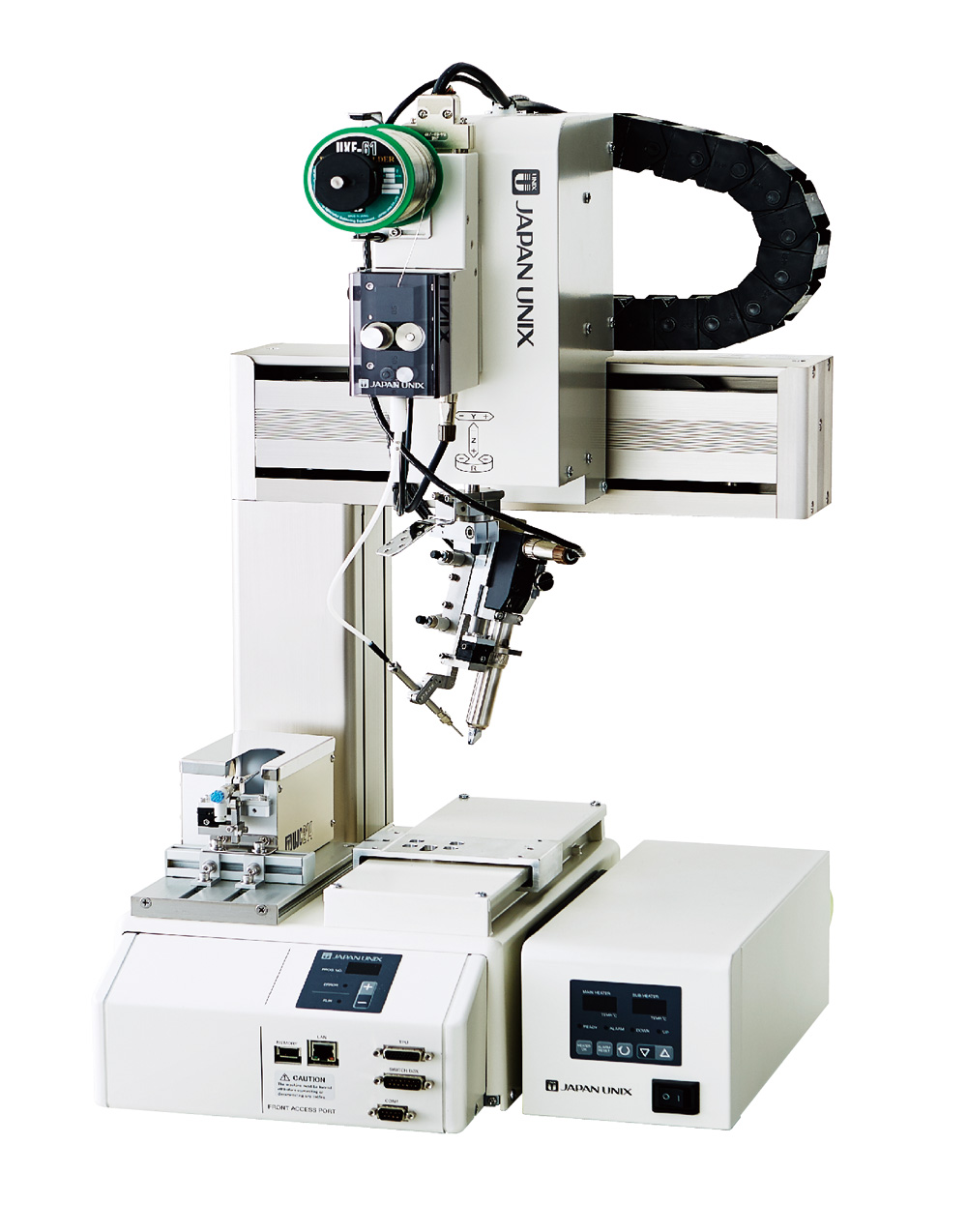
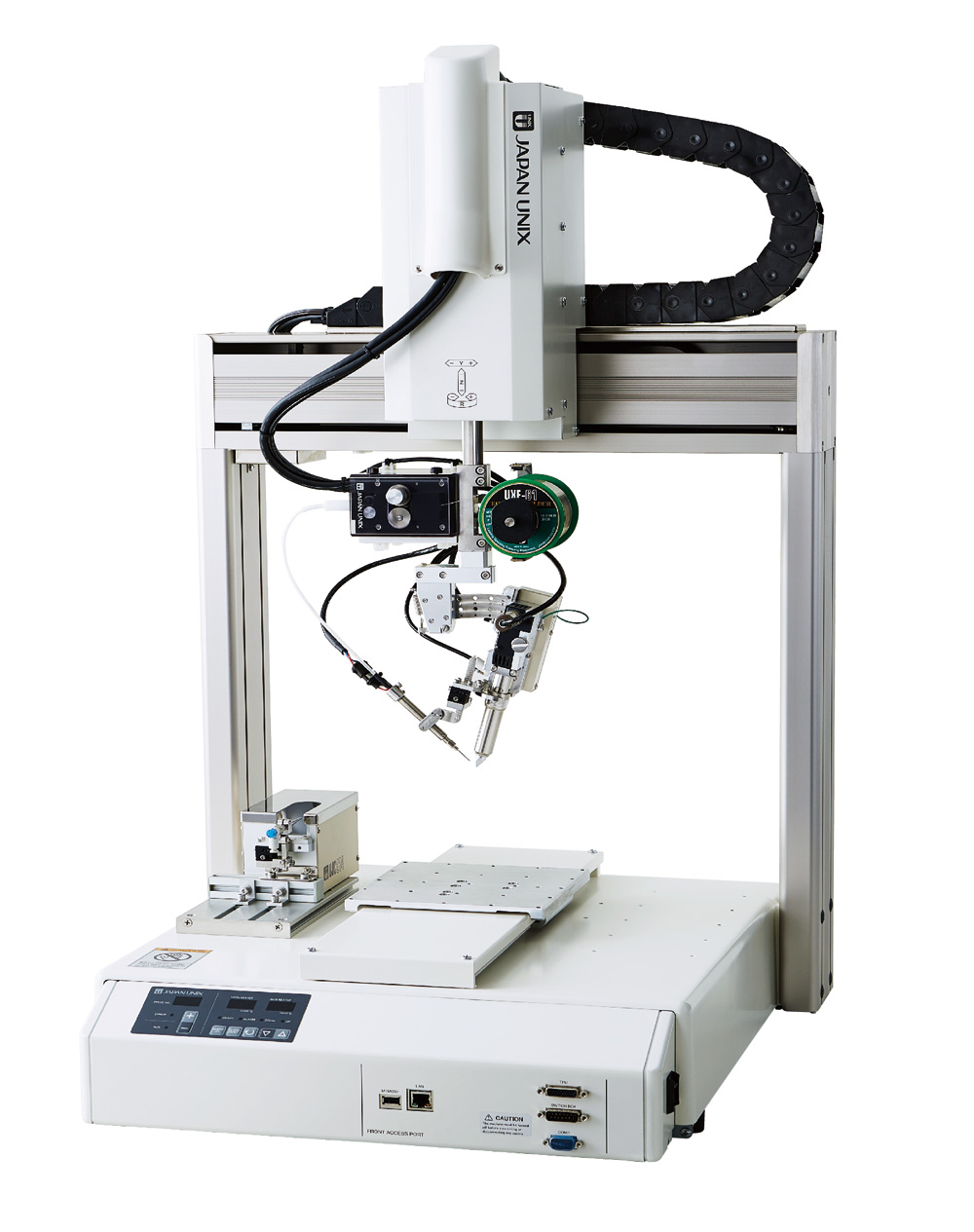
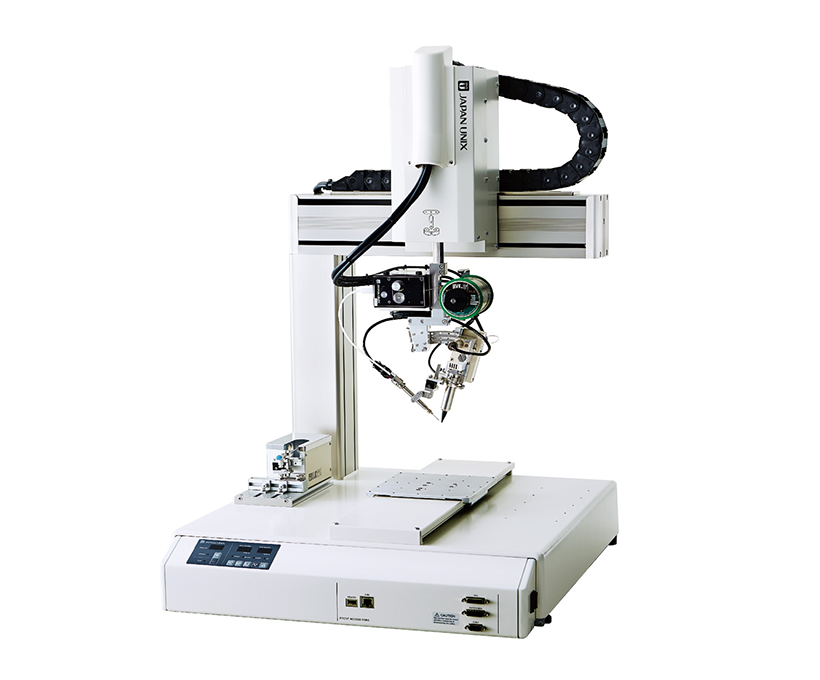
| Model | Type | Worktable | X/Y speed | Z speed | Controller |
|---|---|---|---|---|---|
| DF204S | Compact | 200 × 210 mm | 600 mm/s | 250 mm/s | Standalone soldering controller |
| DF304S | Mid-size | 300 × 275 mm | 900 mm/s | 400 mm/s | Built-in controller |
| DF404S | Wide | 400 × 365 mm | 900 mm/s | 400 mm/s | Built-in controller |
The DF204S is a space-saving compact unit, easy to operate with high soldering reliability. The DF304S covers the widest range of applications. The DF404S offers a long stroke and high payload, suited to large boards and M-shaped substrates.
The three models share the same DF platform; the core differences are worktable size, speed and controller layout. Lock in the model in three steps:
The standard unit has 4 axes; up to 2 auxiliary axes can be added for a maximum of 6 simultaneously controlled axes, enabling multi-angle soldering within a single program. Auxiliary axes can rotate the workpiece, flip the board, tilt angles, turn cylindrical parts and hold wire harnesses — solving complex shapes that conventional robots struggle with. Up to 2 stepper / servo motors can be taught on the teach pendant to coordinate rotary tables, conveyors and other external devices.
For fine production, the camera function is enhanced: on top of the existing position-correction function, auto-calibration and computed CCD correction are added, widening the vision system’s use cases. Computed camera correction lets the robot import up to 3,000 correction values; for tray-arranged parts it can “shoot continuously → work continuously” instead of the repeated “shoot → work → shoot again” loop, significantly shortening cycle time.
Upgraded motors raise the maximum payload from 11 kg to 15 kg (DF304S / DF404S only); DF304S / DF404S reach up to 900 mm/s with a 7 kg tool. The rigidity mechanism of earlier models (DF204S) is improved, raising maximum speed and acceleration, shortening cycle time. Trajectory performance is more stable at high speed for long-term reliable operation.
An optional temperature / leakage detection module measures tip leakage voltage and ground resistance while measuring tip temperature — important for process control. Unstable tip temperature affects joint finish; leakage and transient voltage can damage components internally; from an equipment-protection standpoint, measuring and ensuring tip-to-ground resistance is necessary. Complies with IEC-61191-1 (Ed3 / 2018) and IPC J-STD-001G; performs multiple measurements and automatic tip-temperature compensation.
A new wire feeder simplifies changing wire diameter: swap the feed block, no adjustment needed. Includes a flux-splash-preventing broken-wire feeder, switchable between standard feed and CLEAN-CUT. Point-chart editing builds points / lines / circles / arcs from imported JPEG / DXF / Gerber data on a PC. Direction-specified sorting shortens cycle time for multi-path jobs. R-corner auto-arc function eases editing. Up to 999 programs with per-program tip shape and temperature; optional 3-axis position correction per program.
A conversational program-input system to create, edit and save teach data and custom data on a computer: numeric point setting, spreadsheet-style copy / paste of coordinate data, and graphical point-chart editing of path data.
The teach pendant supports 11 languages: Simplified / Traditional Chinese, Japanese, English, French, Spanish, Italian, German, Korean, Czech and Vietnamese. Fieldbus modules are selectable from DeviceNet / PROFIBUS / CC-Link / EtherNet/IP / PROFINET / CANopen for easy integration with automatic lines.
| Specification | UNIX-DF204S | UNIX-DF304S | UNIX-DF404S |
|---|---|---|---|
| Axes | 4 standard + 2 optional auxiliary (max 6 controlled) | ||
| Travel X / Y / Z | 200 / 250 / 50 mm | 300 / 320 / 100 mm | 400 / 400 / 100 mm |
| R axis | ±360° | ||
| Max workpiece weight | 7 kg | 15 kg | 15 kg |
| Max speed (PTP) X,Y / Z / R | 600 / 250 / 600°/s | 900 / 400 / 900°/s | 900 / 400 / 900°/s |
| Repeatability X,Y / Z / R | ±0.01 mm / ±0.01 mm / ±0.008° | ||
| Max workpiece (fixture) size | 200 × 210 mm | 300 × 275 mm | 400 × 365 mm |
| Programs / points | 999 programs / 32,000 points max | ||
| Tip temperature range | 200 – 450 °C | ||
| Heater power | 250 W (cross heater LS / L) | ||
| Wire diameter | Φ0.3–1.2 mm (std), Φ0.6–1.0 mm (clean cut) | ||
| Dimensions (W×D×H) | 413×387×706 mm | 560×575×934 mm | 584×635×934 mm |
| Power | AC100–120V or AC220–240V 50/60Hz 550W(VA) | ||
| Weight | ~35 kg | ~45 kg | ~52 kg |
Widely used in: automotive electronics, smartphones & 3C modules, temperature sensors, medical pressure sensors (ceramic-substrate wire bonding), PCB terminals, microphone connectors, camera modules and Hall sensors.
They differ by worktable size and payload: DF204S is compact (200×210 mm table, ~7 kg max load, standalone controller); DF304S is mid-size (300×275 mm, 15 kg, built-in controller); DF404S is wide (400×365 mm, 15 kg, built-in controller), suited to large boards and M-shaped substrates.
Standard 4 axes, with up to 2 optional auxiliary axes for a maximum of 6 simultaneously controlled axes — enabling multi-angle soldering in one program. Auxiliary axes can rotate the workpiece or flip the board.
It connects to the factory network / MES (optional), has standard LAN / USB for data export, exports all soldering data to CSV for yield analysis, auto-sends error-alarm e-mails when networked, and offers the optional “Soldering Manager” software.
Tip temperature range is 200–450 °C; wire diameter Φ0.3–1.2 mm (standard) or Φ0.6–1.0 mm (clean cut).
Widely used in automotive electronics, smartphones & 3C modules, temperature sensors, medical pressure sensors (ceramic-substrate wire bonding), PCB terminals, microphone connectors, camera modules and Hall sensors.
A higher-precision heater with the sensing point near the tip gives more accurate control and faster temperature recovery; the heater and tip are separated for independent replacement, and an anti-misalignment locator prevents wrong tip orientation.
© Shenzhen Xiaomachi Technology Co., Ltd. · Authorized JAPAN UNIX distributor · genuine parts, factory warranty, anti-counterfeit guarantee · specifications and pricing subject to confirmation.